
In 2026, Normandy turns its gaze once again to one of its most universal names: Claude Monet. One hundred years after the painter’s death, on December 5, 1926, in Giverny, the region is organizing a series of tributes that place not only the artist back at center stage, but also the setting where his painting found one of its deepest expressions.
Before Giverny: the discovery of Normandy
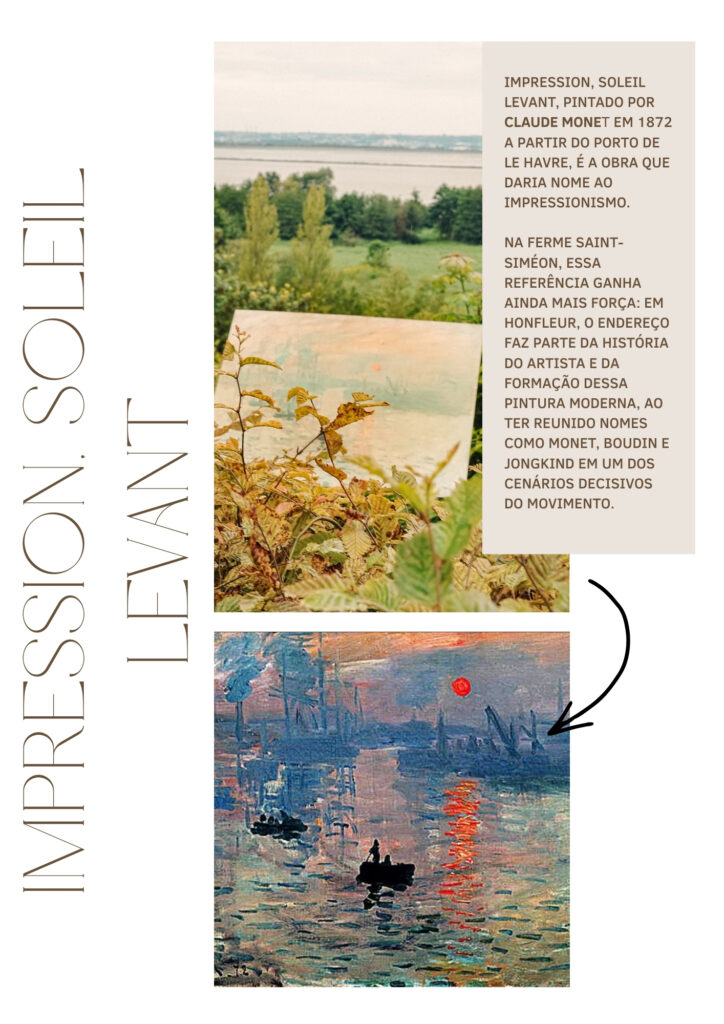
Before Giverny, however, came the discovery of Normandy. Monet was born in Paris in 1840, but it was in Le Havre — where his family moved when he was still a child — that his eye was truly formed. The coastline, the ever-changing sky, the humidity that could alter the color of the water and façades within hours: all of this came before fame, before the celebrated series, even before Impressionism had become a word.
It was also in Le Havre that he met Eugène Boudin, sixteen years his senior, the painter who drew him away from drawing and led him outdoors to paint en plein air. Years later, Monet would acknowledge that debt without hesitation: he owed Boudin the essentials, including the discovery of nature not as a backdrop, but as an experience.
Paris, the Seine, and the language of modern life
In 1859, Monet returned to Paris. The capital offered him what Normandy could not yet provide: artistic exchange, friction, rivalry, and a new visual language. There, he came into contact with a group of young painters who would go on to change the course of art history — Bazille, Renoir, Sisley, Pissarro — and began to build a body of work attentive to the movement of modern life.
After the Franco-Prussian War, he settled in Argenteuil; later, he spent time in Vétheuil and Bougival. Along the Seine, he painted bridges, boats, steam, snow, gardens, riverbanks, trains, and reflections. This was not yet the Monet of the water lilies. But it was already the work of an artist less interested in the solidity of things than in the way they yielded to light.
Giverny as a work of art, not a retreat
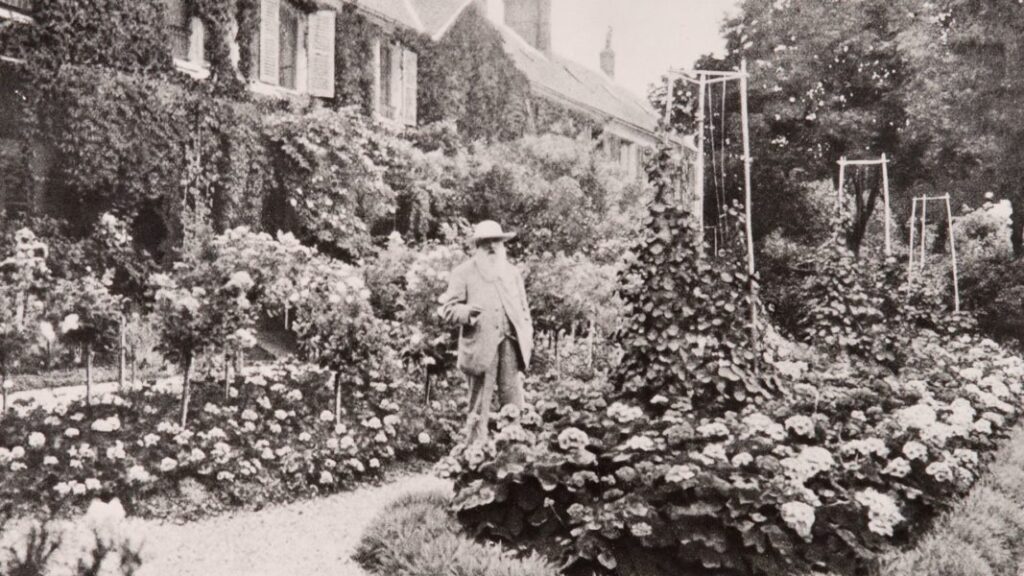
When Monet arrived in Giverny in 1883, he did not find some ready-made romantic refuge to admire. He found a place of work. The house, which he would purchase a few years later, became the center of a life entirely organized around painting, the garden, and time itself.
This is worth insisting on, because Giverny has gradually been turned into an icon — and icons tend to erase the labor that produced them. Nothing there happened by chance. What today seems harmonious, almost inevitable, was imagined, moved, planted, pruned, and remade. Monet lived in Giverny from 1883 to 1926: forty-three years.
Writing to the prefect of the Eure department about his gardens in Giverny, Claude Monet remarked:
“It is merely something for pleasure, for the delight of the eyes, and also a motif for painting.”
Claude Monet
In that single sentence lies the spirit of a place where the master expressed, both in the soil and on canvas, his incomparable gift for the picturesque.
Two gardens, one vision
The gardens of Giverny are arranged around two major spaces: the Clos Normand and the Water Garden.
The Clos Normand: structure and abundance
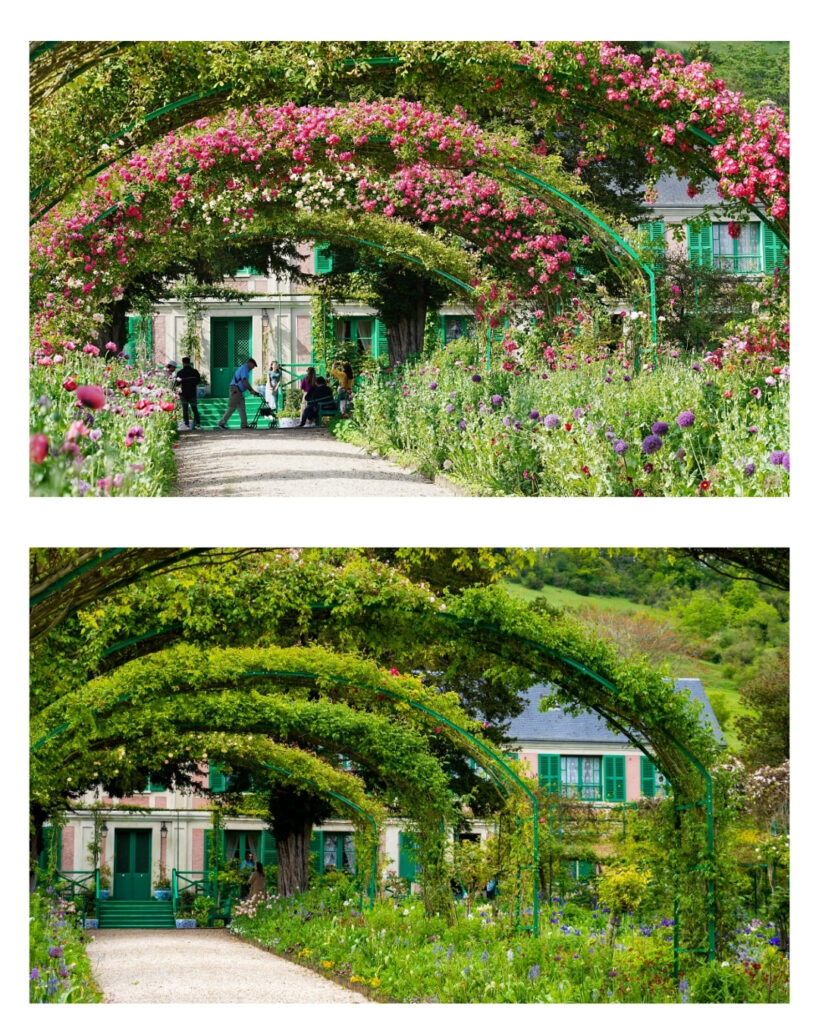
The Clos Normand stretches alongside the pink-fronted house, its walls covered in climbing vines. When Monet settled in Giverny in 1883, he began there a project that would take years: to transform the garden into a kind of painting executed directly in nature.
In its structure, the space recalls the layout of classical gardens, with a central path and perpendicular side alleys creating a series of shifting perspectives. Yet the floral composition breaks any sense of rigidity. Metal arches replaced part of the earlier vegetation, while an abundance of flowers — nasturtiums, roses, jonquils, tulips, daffodils, irises, oriental poppies, peonies, climbing roses, clematis, phlox, delphiniums, daisies, bellflowers, day lilies, marigolds, and sunflowers — unfolds across more than an acre in a palette that is both vibrant and meticulously orchestrated.
Nothing was left to chance. Monet personally chose every element of the garden. Passionate about horticulture, he studied constantly, subscribed to specialist journals, visited exhibitions, and exchanged ideas with some of the leading nurserymen of the late nineteenth century. Alongside his friend Gustave Caillebotte — painter, collector, and patron — he deepened that interest even further, at times experimenting with hybridization.
The Water Garden: landscape reinvented
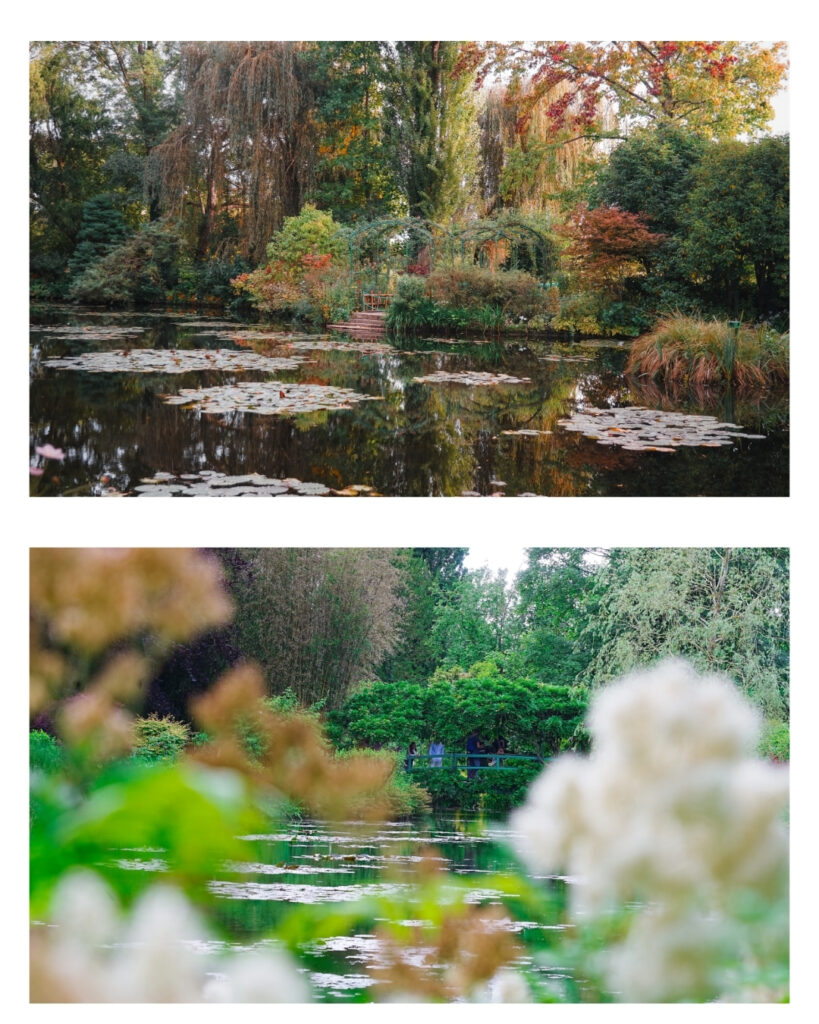
Across the road, on land he acquired in 1893, Monet created the celebrated Water Garden. To do so, he diverted part of the waters of the River Epte and formed an initial pond, later enlarged to its final dimensions.
If the Clos Normand is defined by straight lines, the Water Garden unfolds in gentle curves. Here, the inspiration is unmistakably Japanese. A great admirer of Japanese prints, Monet sought to translate into real landscape his own vision of a Japanese garden.
The result is a place of rare poetry: a mirror of water covered with aquatic plants, including the famous water lilies he would paint countless times; the Japanese bridge, painted green to stand apart from the traditional red associated with the East; the wisteria draped over it, which would also become the subject of several paintings; and the lush vegetation beyond, with weeping willows and groves of bamboo creating an atmosphere almost cut off from the outside world.
Giverny and Normandy
Giverny is undoubtedly a central landmark in Monet’s life and work, but it is far from the whole story of his relationship with Normandy. To extend the experience, one must go beyond the gardens and follow some of the landscapes that shaped his imagination.
In Rouen, the cathedral reveals the almost mutable force of stone under changing light. In Honfleur, the harbor still preserves the delicacy of its maritime atmosphere. In Étretat, the cliffs and the horizon assert themselves with the same dramatic intensity that captivated painters time and again.