
Caen is not a “museum city” in the conventional sense — and perhaps that is precisely why it is sometimes overlooked in fast-paced Normandy itineraries.
Yet it offers a remarkable balance: the scale of a regional capital, a lively local rhythm, and some of the most important historical landmarks in Normandy. For travelers coming from Paris, the logistics are straightforward: direct trains leave from Gare Saint-Lazare, and the journey takes around two hours, sometimes a little more depending on the schedule.
What makes Caen worth a stop — and, above all, worth an overnight stay — is its role as a base for exploring the region. The city lies close to key D-Day and Battle of Normandy sites, making it possible to combine history, coastline, and smaller towns without changing hotels every day. There are even options for reaching beaches and major sites without a car, using connections from Caen.
A city shaped by William the Conqueror
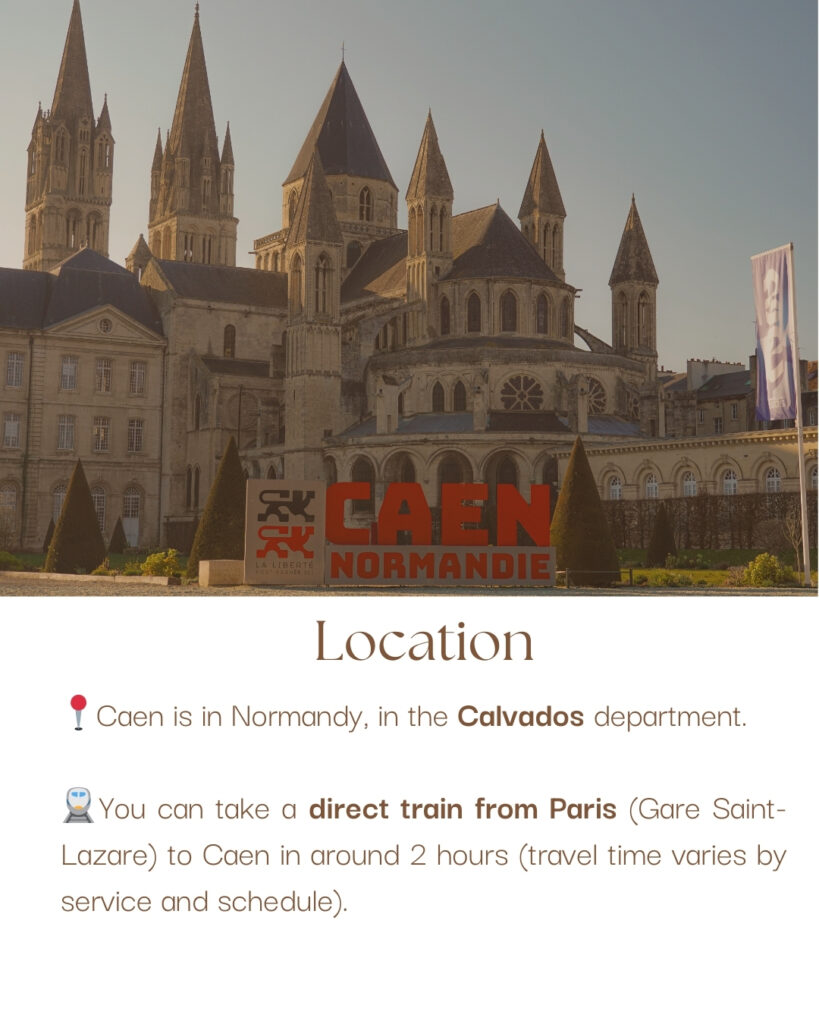
One of the best ways to understand Caen is to begin in the 11th century. Two of its most emblematic monuments — the Abbaye-aux-Hommes and the Château de Caen — are tied to William the Conqueror, a central figure in Norman history and in Normandy’s relationship with England. The castle began to take shape around 1060 and expanded over the centuries into one of the great medieval fortified enclosures in Europe.
This historical backdrop gives meaning to a one-day visit: Caen is best discovered on foot, through an itinerary that alternates religious architecture, urban life, and medieval walls — with well-timed pauses for lunch, coffee, and a closer look at the city itself.
Morning: Abbaye-aux-Hommes, history and civic life at the same address
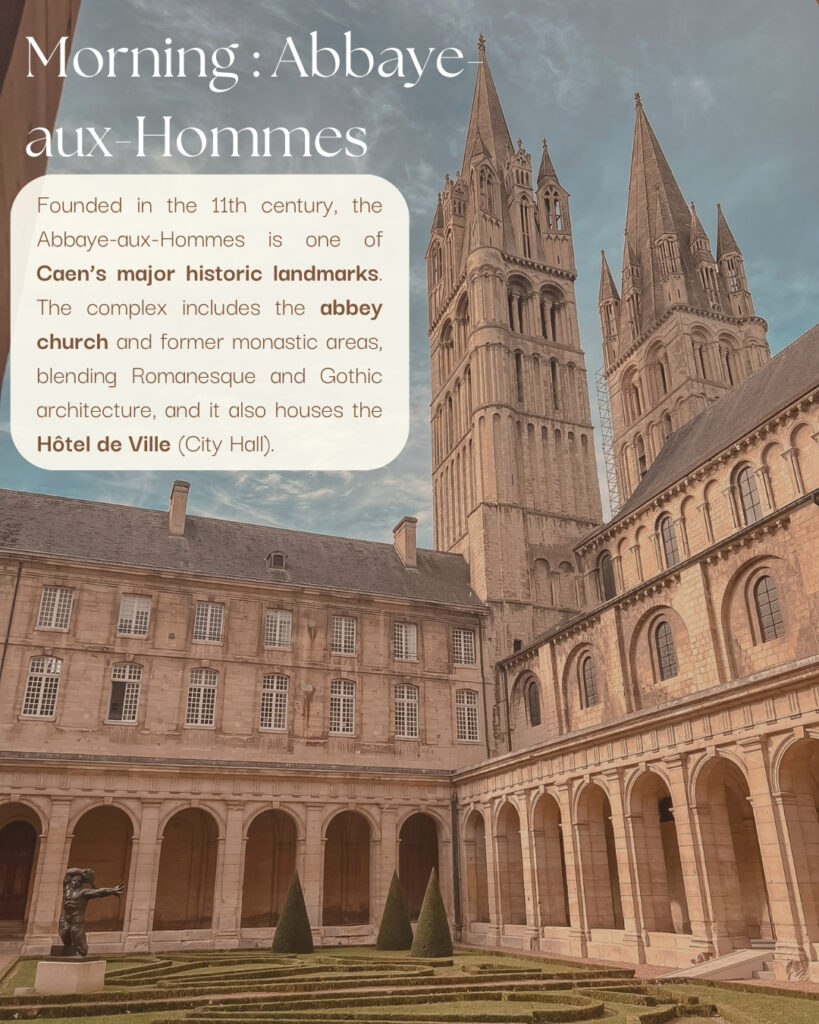
Begin at the Abbaye-aux-Hommes, founded in the 11th century and recognized as one of Caen’s major historic landmarks. The complex includes the abbey church and former monastic buildings; beyond its architectural significance, there is one detail that often surprises visitors: today, it houses the Hôtel de Ville, Caen’s city hall — a vivid example of how heritage remains integrated into the city’s daily administrative life.
The visit appeals equally to those drawn to history and to those looking for strong visual impressions: pale stone, imposing volumes, courtyards, and circulation spaces conceived for a very different rhythm of urban life than the traffic moving around it today.
Pronunciation: “Caen” is short and nasal — something close to kan, but without stretching the sound.
Caen city centre: historic fabric and local life
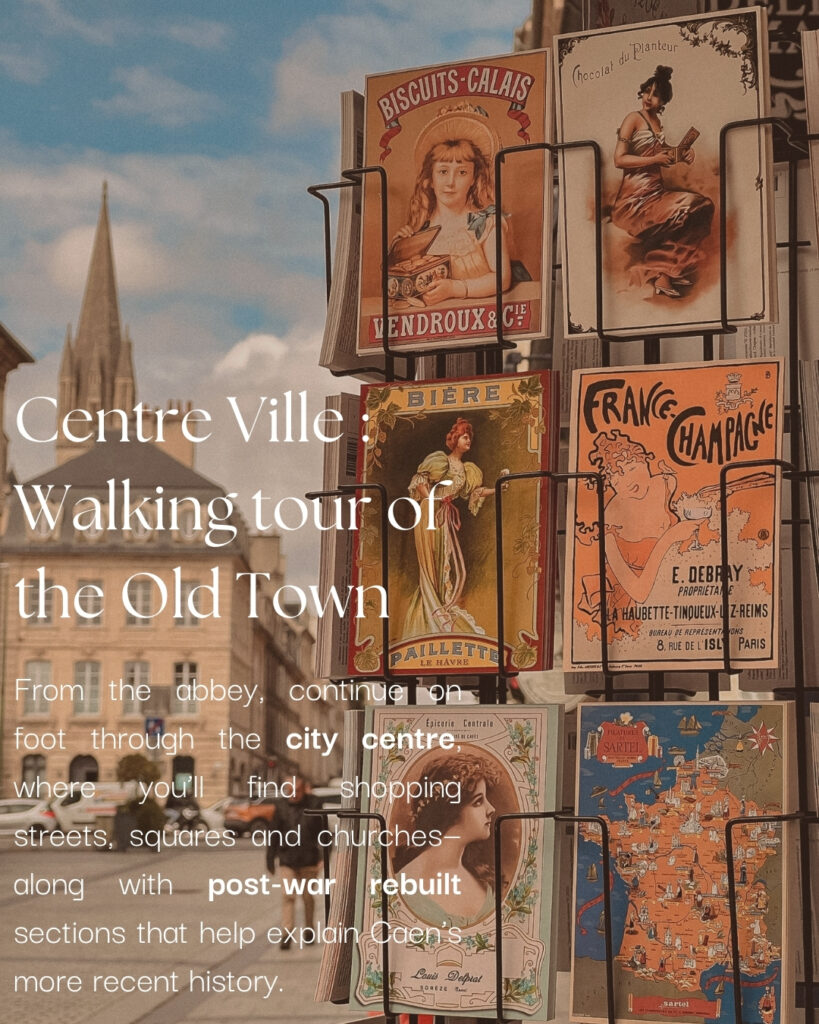
From the abbey, continue on foot toward the centre. Caen is particularly rewarding for travelers who enjoy “reading” a city: the walk reveals both older streets and areas still marked by postwar reconstruction. For those who like to turn a stroll into a narrative, local tourism routes also propose discovery walks that combine the essential highlights with lesser-known corners, blending cobbled streets with more recent architecture.
A practical tip here: rather than trying to see everything, focus on building the story of the day as you go — how the city is organized, where the squares open up, how churches and public buildings appear between shopping streets and everyday life. It is the kind of walk best enjoyed with short pauses for coffee, window displays, and observation.
Lunch in the Quartier du Vaugueux: Caen’s most preserved historic quarter
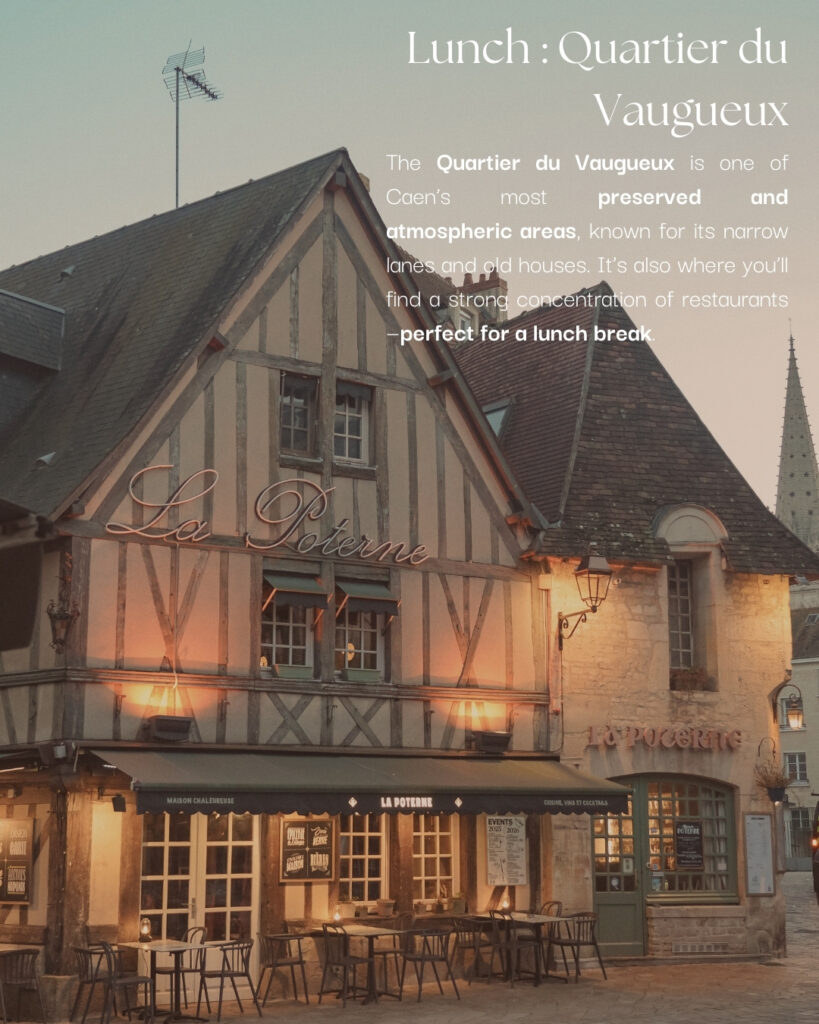
For lunch, the Quartier du Vaugueux often offers exactly what many travelers hope to find in urban Normandy: narrow lanes, old houses, and an atmosphere that invites une petite pause. Local sources describe Vaugueux as one of the city’s emblematic medieval quarters, with stone-paved streets, traditional buildings, and a strong concentration of restaurants and cafés — a classic address for slowing down and enjoying Norman cuisine.
In practice, this means you can adapt lunch to your pace: enjoy something quick and continue the itinerary, or linger over the meal and keep the afternoon lighter. Visually, Vaugueux is also one of the most photogenic corners of Caen, with cobblestones, historic façades, and terraces spilling into the street.
Afternoon: Château de Caen, fortified park and cultural landmark
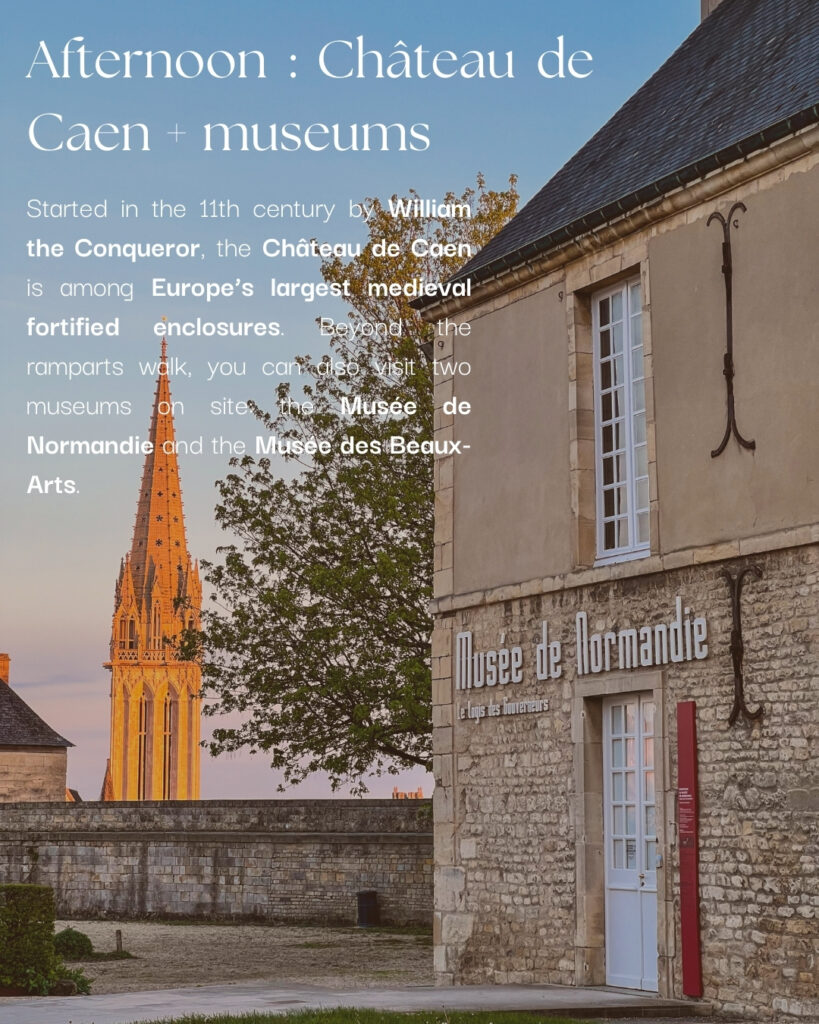
After lunch, the Château de Caen is less a castle to admire from the outside than a vast urban space to explore from within. The inner grounds are freely accessible, with interpretation routes and areas to sit and pause — an invitation to walk slowly among the ramparts.
The site becomes even more interesting when one pays attention to its historical layers. Over the centuries, the castle evolved from ducal fortress to military installation, and those transformations remain legible throughout the circuit, both in the ramparts and in the preserved structures around the museum quarter. In recent years, the site has also emphasized a more contemporary dimension, with outdoor artworks and interventions linked to the Millénaire de Caen, creating a visit that combines heritage, green space, and visual culture.
Within the walls, the experience deepens through the museums. The Musée de Normandie occupies the former Logis des Gouverneurs, a building long associated with local power — from the medieval era to the French Revolution — later incorporated into military administration, damaged during the 1944 bombings, and eventually restored and converted into a museum. The Musée des Beaux-Arts, by contrast, is housed in a contemporary building and presents European painting collections along with a sculpture trail around it — a balance of history and art that works particularly well in the second half of the day.
Even for those who choose not to visit the exhibitions, simply walking through the castle fulfills an essential purpose: it places Caen in perspective. From the higher points and large open interiors, visitors grasp the strategic position of the complex and the way it still shapes the cityscape of the centre.
Late afternoon: sunset at the château
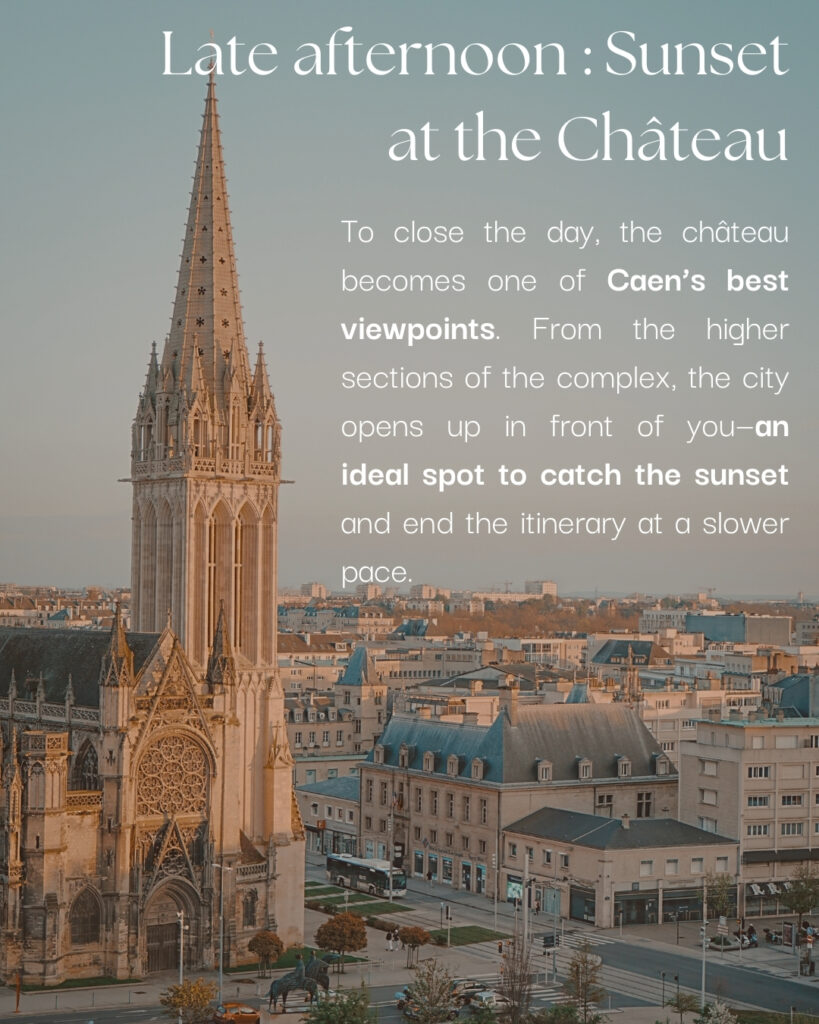
If the weather is clear, it is worth saving a little time to return to the higher parts of the site and simply pause. In the late afternoon, the changing light transforms the texture of the stone, and the château becomes one of the best places for an open view over Caen — a fitting end to a day that begins with religious architecture and closes on the city’s medieval walls.
If you have more time: the Mémorial de Caen and the “Normandy of memory”
If you can extend your stay, Caen also offers one of the most important visits for understanding the Second World War in the region: the Mémorial de Caen. Just a few kilometres from the centre and on the natural route toward the D-Day beaches, the museum offers an immersive journey through the 20th century — from the Second World War to the Cold War — supported by documents, objects, and audiovisual material.
Its narrative places strong emphasis on the Battle of Normandy, D-Day, and their aftermath, making it an excellent introduction before continuing on to the beaches, cemeteries, and coastal museums. And because this subject involves many sites, timelines, and layers of detail, visitors may also choose a specialist tour: “My Normandy Tour” offers private tours in English, which can be tailored to a particular interest you would like to explore in depth, or designed as a broader experience covering the essential sites with context and carefully selected stops. For travelers without a car, urban transport lines also connect the city centre and the train station to the museum.